


“I saw an ad for running shoes on Instagram, so I visited the store’s product page, read a review, and bought them.” — your (ideal) customer
As much as we’d like to think the steps someone takes to purchase from your store are always this simple, the reality is: they’re often far from it! Consumers switch between devices, channels, and platforms in the weeks leading up to a purchase.
And this information—their journey—can be crucial for you as you scale your brand.
A customer journey map shows the activities shoppers undergo prior to purchasing a product online (and can even extend to post-purchase activity). By understanding the pathway to purchase through your ecommerce site, you can better craft the right messaging to reach target customers, at the right time.
Below we’ll share how to create your own customer journey map, with tips on how to spot drop-off points and fix them.
The result? A positive customer experience that makes someone’s decision to purchase faster, easier, and friction-free.
This guide will cover:
A customer journey map is a visual representation of how people purchase products. You might see it called the “buyer journey” or “user journey map” as well.
In the case of ecommerce brands, a customer journey map shows:
Take a look at this customer journey map example below by Nielsen Norman Group, which shows the touchpoints a customer has prior to buying a new car.
So-called “Emotional Eric” goes from seeing a TV commercial about a car company, through to downloading the mobile app, visiting a dealership, and driving away with a new vehicle. The map displays Eric’s thoughts, feelings, and considerations at each point in the journey, giving the dealership’s marketers greater insight into what Eric needs to see before converting.

There are up to 24 million ecommerce websites in the world—many of which sell comparable products to those in your own inventory. Customers have more choices than ever. But what made existing customers—those who’ve given you their hard-earned cash—choose you?
Understanding the customer’s thoughts, feelings, and objections at each touchpoint gives you greater insight to improve your online store’s conversion rate.
Using the example of Emotional Eric, the dealership selling the car can use the customer journey map to:

Not convinced on the power of journey mapping? High-performing teams are 1.6 times more likely to use customer journey management.
Though these personalization tactics aren’t just marketing checkboxes to tick. It’s a purchase motivator for the 65% of people who’d become a long-term customer of a store that provides a positive experience throughout the entire customer journey.
“Customer journey mapping heavily relies upon how the information is relayed to its target audience. The message should be clear and concise so that even a layperson has no trouble understanding the message.”
— Albert Vaisman, founder of Soxy
When creating your own ecommerce customer journey map, you can focus on components of the journey (instead of taking on absolutely everything).
Though, as seen below, the highest performers are three times more likely to use customer journey orchestration, and two times more likely to analyze customer interactions over three or more channels over time. There’s a connection between how detailed you map your customer journey and the results you’ll reap!
This can guide your investment in the process.

#cta-visual-pb#Create a high-converting shopping experience that meets customers where they’re atYour perfect store is waiting for you to build it. Start building with Shogun today
Ready to uncover the steps a customer takes before purchasing your product? Here’s a step-by-step journey mapping process to create one for your ecommerce business.
It’s impossible to lump all customers in one bucket. Different customers have different preferences, and use cases differ from product to product.
People who buy your toothpaste bundle won’t be solving the same problems as customers purchasing a teeth whitening kit.
“Some ecommerce brands don’t research enough, or the research they carry out is weak. You can’t start making a journey map through guessing.”
— Ai Hiura, CMO and chief editor at FAVERIE
When building your customer journey map, don’t paint all customers with the same brush. Segment your audience by the traits they share, such as:
Once you’ve isolated your customer personas with segmentation, it’s time to conduct research.
Our goal at this point is to uncover the touchpoints a potential customer has prior to purchasing. Here’s how you can find them.
There’s no better way to understand your customers than talking to them.
Aaron Masterson, founder of Local Furniture Outlet, says, “While it may be tempting to believe that we know more about our customers than we do, doing additional research that provides valuable data through interviews and analytics is the best way to approach building a customer journey map.
“Since customer journey maps are all about customers, it would be a mistake not to involve them when building one. Without putting customers at the center of focus, it is not possible to completely represent their experiences.”
Find the touchpoints previous customers had with your brand via order confirmation emails. Follow-up their purchase with an invite to complete a customer feedback survey—or, for more in-depth data, voice of the customer interviews.
Key questions to ask in these conversations include:
You can use a market research repository like Userzoom or Aurelius to store all feedback—or a classic spreadsheet. Common themes will begin to appear over time, unveiling the touchpoints for your customer journey map.
#cta-paragraph-pb#Read more on creating buyer profiles: How—And Why—You Should Use Buyer Profiles and Quizzes for Your Store
While customer interviews are a great source of data, you’re not going to get the full picture of how people engage with your brand pre-purchase through interviews alone.
People forget about steps they’ve taken, thoughts they had, or content they engaged with. Customers also have a different point of view—even if they did take the same path to purchase.
Lift the lid on how potential customers engage with your website through:

Albert Vaisman explains how they get their starting point mapped at Soxy: “I use direct traffic data when building a customer journey map. This measure provides me insight into how the target audience perceives my brand.
“I use direct traffic in my web analytics tool to observe the number of visitors who manually typed in my company’s URL. Then I compare this metric to other traffic sources. [I can also look at] my website’s bounce rate, optimizing accordingly.”
Social media is a hive of activity. Your ecommerce brand can listen in on conversations—even if your brand name isn’t explicitly mentioned—to understand the customer journey for products in your industry.
Adrienne Barnes, founder of Best Buyer Persona, is currently working with her client on this process. For shoe retailer Kuru Footwear, “We’re really trying to understand what was going on when a customer was encouraged to start looking for these shoes in particular.
“We’re trying to figure out when, in a buyer journey, do people go from being aware that they have a problem, to being solution or product aware?”
Using the orthopedic shoe example, Adrienne says the prospective customer is likely thinking, “I know that my feet hurt. I need something that’ll stop my feet from hurting. What are the things that I can do?” At this point, they start looking at shoes, insoles, surgery, or chiropractic care. You can see that on social media.”
“Delving into the social media data of the people who follow your brand can supply you with their age, gender, languages, and locations. You can also identify your audience’s interests, which can help you optimize your content strategy to address your target audience’s needs at every stage of the customer journey.”
— Shaunak Amin, co-founder and CEO of SnackMagic
“A customer journey map is an organization-wide undertaking because the customer interacts with basically every part of a business,” says Stephen Light, CMO and co-owner of Nolah Mattress.
“Maps simply won’t be as effective as they could be without input from those actually delivering the customer’s experience.”
Merge the data you’ve got at this point from customers with your internal team feedback. Consult the following people to corroborate your existing data:
Chances are, they’ll have direct experience talking with your customers—valuable data you should add to your buyer journey map.
Not all data you collect throughout this process is 100% accurate.
“If you don’t talk to your customers and you’re not validating the things you see in your data, you could be putting the steps in the wrong place or making assumptions that aren’t true,” says Adrienne Barnes.
“We really put a microscope on the moment they decided to change or purchase a new product. That helps me identify: was it on social media? Was it within a Facebook group? An ad? I like to ask via interviews and verify via digital intelligence.”
As Adrienne says:
“People tell me, ‘I first heard about the product because I saw an ad on Instagram.’ I can go and look through analytics and internal data to see whether we’re actually doing that—including the conversions we’ve had and what [value props] we’re talking to within the ad.”
At this point, you have more data than you know what to do with. It’s both a blessing and a curse.
Start making sense of your data by organizing touchpoints into different silos.
There’s no “best practice” for labelling these categories, though it makes sense to model your customer journey map on the marketing funnel.
Let’s put this into practice for building a customer journey map for an ecommerce business. For example, shoppers purchasing blue light-blocking glasses have the following touchpoints at each stage:
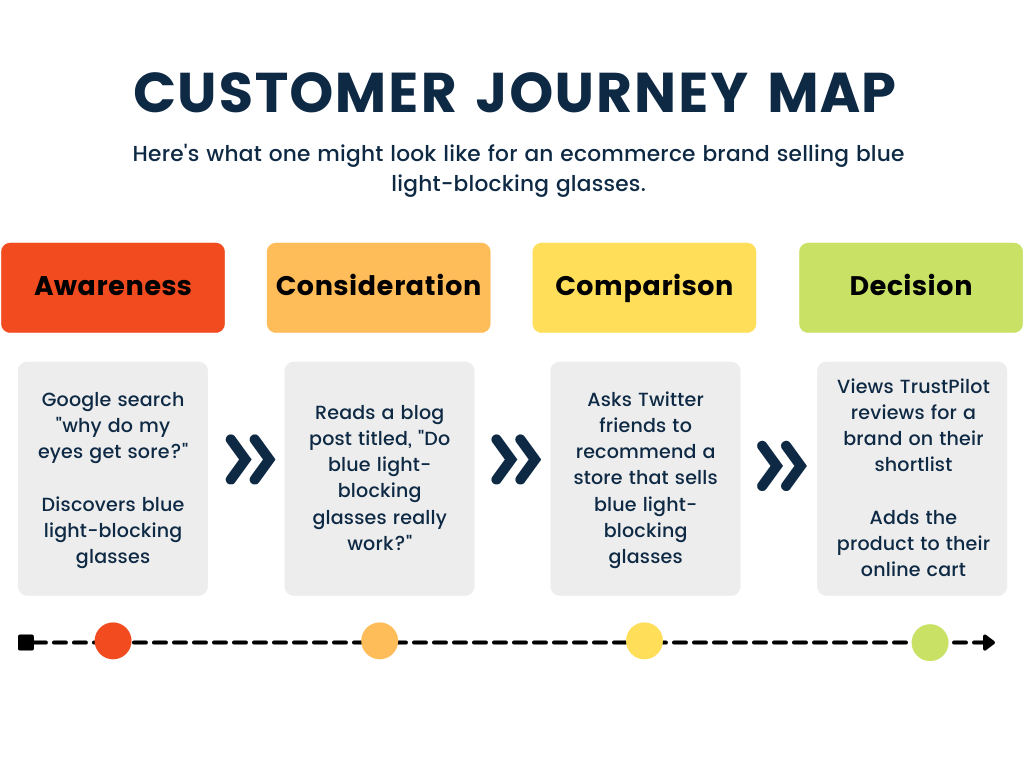
Next, you’ll add context around the thoughts and feelings the customer experiences at each stage in the buyer’s journey. This includes:
Then, refine every interaction you have with your customer—including site content/copy, messaging, and your marketing strategy—to address each point at the right time. Each is an opportunity to personalize your approach and close the deal.
For example, if we learn that those shopping for blue light glasses need to see proof that they work (because they’ve tried solutions that don’t), you’re going to want to include this prominently across your ecommerce site:
Consider as well that user-generated content could be a great way to address something like the consideration or comparison phases of the journey.
If we realize that in the consideration stage the customer wants to try on the glasses, maybe your eyewear brand needs to invest in a virtual try-on interaction on the site to help alleviate questions the customer has around the size of the glasses (something that’s difficult to judge online vs. in-store).
Warby Parker takes this approach with its mobile app. Shoppers can overlay eyewear onto a livestream of their face—much like a Snapchat filter—to see which suits them.

Finally, as customers reach the decision stage, they need one final vote of confidence before hitting “confirm order.”
If they’re struggling to overcome an expensive pair of blue light-blocking glasses, for example:
#cta-visual-pb#Create a high-converting shopping experience that meets customers where they’re atYour perfect store is waiting for you to build it. Start building with Shogun today
The goal of a customer journey map is to uncover the thoughts and feelings your target customer has prior to purchasing your product.
But not everyone will make it through the entire funnel. Customers fall out of the buying journey for several reasons—some of which are outside of your control; others you have the power to prevent.
Use the data collected earlier, including Google Analytics’ Shopping Behavior Analysis report, to uncover points at which customers stop engaging with your brand. This might be:
Once you isolate where customers are dropping off, you can make tweaks to your site and marketing materials to fix!
Found the gaps in your customer journey? Next, plug the leaks and improve your conversion rate.
You’ll get customers from homepage to products, to purchase, and into post-purchase flows with as little friction as possible when you put yourself in the customer’s shoes.
For example, a consumer in the consideration stage falls out of the buying journey because they switched devices and couldn’t remember the name of the site they viewed. The potential fix might be a pop-up modal encouraging your website visitors to opt into SMS or email marketing (so the drop-off isn’t permanent!).
Similarly, you might find that customers fall out of the purchase journey because they haven’t found a solution to their problem. In this case, understand the customer’s perspective and:
As we’ve covered, in its simplest form, a customer journey map shows the touchpoints a shopper takes when purchasing items online, and you can even carry it into post-purchase.
Remember that while we can do our best to organize these touchpoints, your ecommerce customer journey map may never be entirely accurate—and that’s ok! As Adrienne Barnes says, “We like to think of a customer journey map as a linear process, but in reality, it’s pretty convoluted and messy.
“Have an awareness that the customer isn’t always going to follow your streamlined idea of a buyer journey. They have a whole life that purchasing your product is a minuscule piece of.”
Overall, work to uncover the touchpoints customers have for your ecommerce brand and craft the messaging your shoppers need. You’ll position your products in the right place, at the right time, to the right people—a winning formula for sales.


